



Month Ending May 31, 2026

Published first week of each month: A deeper dive into economic trends, investment strategies, and what it all means for your financial plan.

Strong Earnings Growth Leads the Way in May

Markets wrapped up May on a strong note, extending the rally that began after the March sell-off. While ongoing geopolitical risks continue to exist, hopes for a negotiated end to the Middle East conflict and strong corporate earnings buoyed investor sentiment.

Monthly Quick Hits

Beyond the Headlines

Strong Earnings Growth Leads the Way in May

Fixed Income Update

A Volatile Month

Geopolitical and Economic Update

Mixed Economic Data and Headline Risks

Looking Ahead

While Risks Exist, Fundamentals Should Provide Support for Markets


Beyond the Headlines:

Strong Earnings Growth Leads the Way in May

Against a backdrop of ongoing negotiations to end the war in the Middle East and a 17 percent decline in oil prices, May proved to be another strong month for equity investors. Continued impressive earnings reports from corporate America helped set the tone and provide support to markets despite the many headwinds consumers and the economy are facing.

The Nasdaq, S&P 500, and Dow Jones Industrial Average rallied strongly in May. All three indices closed the month at record highs, illustrating the breadth in the market. International markets also surged higher.

First-quarter earnings season is basically over, with 96 percent of index constituents having released their earnings. S&P 500 companies have reported earnings growth of 28.6 percent. This rate is the strongest growth we have seen in almost five years and more than double the growth rate expected by analysts on March 31. In even better news, second-quarter earnings estimates have increased and full-year 2026 estimates have risen 7.6 percent since the conflict in the Middle East began. This is yet again a strong indication that, over the long run, fundamentals drive performance and that remains a good sign for investors.

The Magnificent Seven stocks—Alphabet, Amazon, Apple, Meta, Microsoft, Nvidia, and Tesla—have continued to put up impressive earnings growth and are now expected to deliver 37 percent growth in 2026. But the other 493 names in the index are now also putting up strong growth rates. Analysts are expecting 18 percent growth for these companies this year after 4 percent and 10 percent in 2024 and 2025, respectively. This breadth in earnings should provide a supportive backdrop going forward. 

The Takeaway


  • U.S. equity markets continued their rally after the March decline and closed at record highs.
  • Strong fundamentals, seen through the lens of the best S&P 500 earnings growth rate in almost five years, provided market support.  

Fixed Income Update:

A Volatile Month

On the other side of the portfolio, bonds had a volatile month, selling off in the middle of May due to reports showing accelerating inflation because of pressure from higher oil prices. However, reported progress on the Middle East settlement talks eased some of the concerns about inflation, and by the end of the month, bonds had recovered and eked out a small gain.

Yields on the 10-year U.S. Treasury spiked in the middle of the month to 4.67 percent. This was the highest rate seen in that portion of the fixed income curve since January 2025. But as bonds rallied in the back half of the month, the 10-year yield declined and closed the month at 4.46 percent.

The Takeaway


  • Bond returns were slightly positive in May after a volatile month.
  • 10-year U.S. Treasury yields closed the month near 4.50 percent after an inflation-induced sell-off.  

arrow up  0.31%

In May Bloomberg Aggregate Bond Index

arrow up  0.49%

In May Bloomberg U.S Corporate High Yield Index

Geopolitical and Economic Update:

Mixed Economic Data and Headline Risks

The economic updates released last month were mixed but continued to indicate a growing economy. Not surprisingly given the recent surge in oil prices, both the Consumer Price Index (CPI) and the Producer Price Index (PPI) came in higher than anticipated for April. Consumer prices rose at an annual rate of 3.81 percent. Even more concerning was the increase in producer prices, which rose 6 percent. While we are still a long way from inflation reaching the levels seen in 2022, when the Fed reacted by raising interest rates aggressively, this needs to be watched going forward. Without a settlement in the Middle East that fully reopens the Strait of Hormuz and returns oil supply to prewar level, sticky inflation will continue to be an issue for markets. 

On the positive front, the April employment report again came in above expectations, with 115,000 jobs created. This followed March’s strong 185,000 jobs created. Personal spending also rose for the month following strong spending data in the previous month. Put together, this indicates that consumers are still in a solid place despite the rise in oil prices.

Solid job growth and a consumer that continues to spend should buy the Federal Reserve time to wait to see the path for inflation before needing to adjust interest rate policy. This also allows new Fed chair Kevin Warsh time to transition to his new role without needing to immediately react to any deteriorating data.
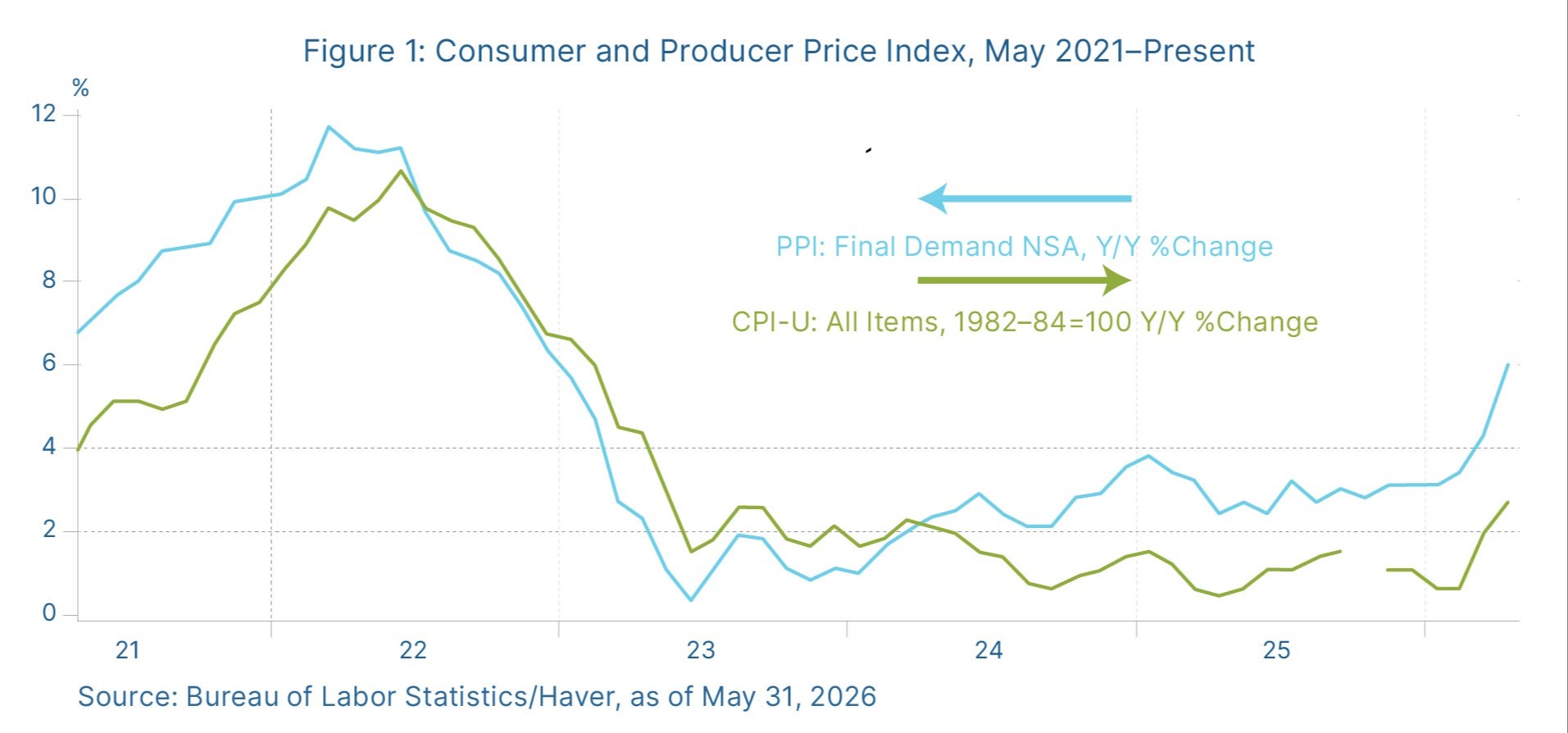

Graph

The Takeaway


  • Accelerating inflation is a concern but not yet enough to make the Fed act.
  • Jobs growth and consumer spending continue to be good signs for positive economic growth.

Looking Ahead:

While Risks Exist, Fundamentals Should Provide Support for Markets

War in the Middle East, surging oil prices, accelerating inflation, and transition at the Fed have dominated the news cycle this year. All that uncertainty taken in a vacuum doesn’t seem like a backdrop conducive to higher equity returns. Yet the markets have climbed the wall of worry since a short sell-off in March.
This year provides another lesson that, while in the short term, headlines will move markets, over the long term, stocks trade on underlying fundamentals. The corporate earnings story has been strong as accelerating spending on artificial intelligence (AI) infrastructure is powering strong earnings growth across multiple sectors participating in the buildout. Tech demand for AI eventually flows through to industrial companies, materials providers, and power companies.

So, while risks certainly exist and will continue to do so, overall, we remain in a pretty good spot when looking at the economic backdrop and corporate fundamentals, both of which should be supportive of markets. While short-term volatility is certainly possible given the heightened level of uncertainty, the most likely path forward in our view is for continued slow economic growth, strong corporate earnings, and market appreciation over the long term.

Given the current backdrop, we believe the best way to navigate all the uncertainties facing the economy while still benefiting from the strength in AI adoption is through diversified portfolios that meet long-term investment objectives. If concerns remain, however, you should speak to your financial advisor to go over your financial plans.

Disclosure: This material is intended for informational/educational purposes only and should not be construed as investment advice, a solicitation, or a recommendation to buy or sell any security or investment product. Please contact your financial professional for more information specific to your situation.

Certain sections of this commentary contain forward-looking statements based on our reasonable expectations, estimates, projections, and assumptions. Forward-looking statements are not guarantees of future performance and involve certain risks and uncertainties, which are difficult to predict. Past performance is not indicative of future results. Diversification does not assure a profit or protect against loss in declining markets. All indices are unmanaged and investors cannot invest directly into an index. The Dow Jones Industrial Average is a price-weighted average of 30 actively traded blue-chip stocks. The S&P 500 Index is a broad-based measurement of changes in stock market conditions based on the average performance of 500 widely held common stocks. The Nasdaq Composite Index measures the performance of all issues listed in the Nasdaq Stock Market, except for rights, warrants, units, and convertible debentures. The MSCI EAFE Index is a float-adjusted market capitalization index designed to measure developed market equity performance, excluding the U.S. and Canada. The MSCI Emerging Markets Index is a market capitalization-weighted index composed of companies representative of the market structure of 26 emerging market countries in Europe, Latin America, and the Pacific Basin. It excludes closed markets and those shares in otherwise free markets that are not purchasable by foreigners. The Bloomberg Aggregate Bond Index is an unmanaged market value-weighted index representing securities that are SEC-registered, taxable, and dollar-denominated. It covers the U.S. investment-grade fixed-rate bond market, with index components for a combination of the Bloomberg government and corporate securities, mortgage-backed pass-through securities, and asset-backed securities. The Bloomberg U.S. Corporate High Yield Index covers the USD-denominated, non-investment-grade, fixed-rate, taxable corporate bond market. Securities are classified as high-yield if the middle rating of Moody’s, Fitch, and S&P is Ba1/BB+/BB+ or below. One basis point (bp) is equal to 1/100th of 1 percent, or 0.01 percent. 


Authored by Chris Fasciano, chief market strategist, and Sam Millette, director, fixed income, at Commonwealth Financial Network®.

© 2026 Commonwealth Financial Network®


Let’s Talk About Your Financial Future

Whether you’re navigating a volatile market or preparing for the future, we’re here to help.

Schedule a Consultation